Real templates, rubrics, courses, and guidance documents for embedding AI literacy into your courses, organized by discipline. Pulled from actual institutions and organizations already doing this work, not generic advice.
Sha’Kia Riggins · Integrating AI into Teaching and Learning
Computing & IT
Discipline track
For computer science, data science, and IT programs adjusting to AI-assisted coding, agents, and “vibe coding” as a new way students build software.
Everything You Need to Start Vibe Coding (From Scratch) — a plain-language primer on AI-assisted coding, built from a talk given to high school students new to the idea.
Framework
AI Across the Curriculum Model
ScienceDirect — Computers and Education: AI
A working model for a faculty subcommittee that reviews existing computing courses and tags where AI-literacy competencies already show up, so you’re mapping onto real syllabi instead of starting blank.
Rubrics for AI-Enabled Engineering & Computing Assignments
IDEEAS Lab
Ready-to-adapt rubric templates that grade both technical competency and how appropriately a student used AI during ideation, debugging, or documentation.
A study of how intro and advanced programming students actually behave when building software with AI tools, useful for setting realistic guardrails rather than guessing.
A documented, three-part classroom exercise where students evaluate LLM outputs against real business tasks — copy the structure directly into a finance or marketing course.
A six-pillar governance framework covering curriculum, faculty incentives, and assessment, plus a look at how Wharton’s shared prompt library lowers the risk of solo experimentation.
For nursing, allied health, and clinical programs weighing AI’s efficiency against patient-safety, privacy, and integrity concerns.
Elevating Education with AI: Practical Strategies for Nurse Educators — keeping faculty, not the tool, in the driver’s seat of clinical teaching decisions.
Framework
A Five-Tier Framework for AI Use in Nursing Coursework
ScienceDirect — Nurse Education Today
A tiered model for calibrating exactly how much AI assistance is appropriate across different assignment types, instead of a single blanket policy.
Student Guidelines for Safe and Responsible Use of AI
Galen College of Nursing
A ready-to-adapt policy covering disclosure, protecting patient and peer information, and clinical-safety boundaries — attach it directly to any assignment.
For writing, humanities, and gen-ed courses, where AI intersects most directly with a student’s own voice and thinking.
Designing Writing Assignments in the Age of Generative AI — Notre Dame’s University Writing Program on redesigning assignments rather than policing them.
Guide
AI Literacy Frameworks for Higher Education
Every Learner Everywhere
A side-by-side comparison of the WCET, EDUCAUSE, Digital Promise, and UNESCO frameworks to help you pick the one that best fits your outcomes.
Guidance for Generative AI in Education and Research
UNESCO
The foundational global policy guidance on human-centered, equitable AI adoption in education — useful context for any department-level policy conversation.
New Initiatives and Accomplishments at Data B.I.T.S., LLC
At Data B.I.T.S., LLC, our mission has always been rooted in the belief that anyone with a passion for technology should have the opportunity to contribute to its growth. Under the leadership of our CEO, Sha’Kia Riggins, MSIT, the firm has evolved from its foundations in meticulous database management and web hosting into a national powerhouse for Artificial Intelligence (AI) education, ethical implementation, and technical strategy.
As we move further into 2026, we are proud to share several major milestones and new initiatives that position Data B.I.T.S., LLC at the forefront of the AI era.
Democratizing AI through Foundational Authorship
One of our most significant accomplishments this year is the release of Artificial Intelligence and Machine Learning: Concepts, Applications, and Ethical Considerations, co-authored by our CEO. This foundational text is designed to help students and professionals move beyond “black-box thinking” to actually developing and deploying real AI systems responsibly. With an updated revision scheduled for October 2026, this work is already being integrated into high-level academic pilots, including a Class Test Semester Mentorship at Texas A&M University-Corpus Christi.
Scaling Impact through Strategic Industry Partnerships
Data B.I.T.S., LLC continues to bridge the gap between high-level industry standards and practical workforce training. Our CEO’s role as an Intel® AI for Workforce Lead Facilitator allows our firm to help institutions nationwide map and implement industry-aligned AI curricula.
Recently, we have expanded our reach through several high-profile engagements:
Nassau County Chamber of Commerce: We have officially been confirmed for a 6-hour AI Business Academy boot camp. This session will empower over 40 business leaders to create efficient AI workflows and utilize autonomous agents.
Federal Reserve Bank of Atlanta: CEO Sha’Kia Riggins was recently invited to provide expert insights during a virtual roundtable on how AI and emerging technologies intersect with workforce training and institutional operations.
City Year Digital Literacy: In October 2026, we will lead an in-person, intensive Digital Literacy 102-AI workshop in Downtown Jacksonville, training 75 participants in holistic AI support and technical proficiency.
Pioneering “Personal AI” with Digital Twins
Innovation is the heartbeat of Data B.I.T.S., LLC. We are currently pioneering research into “Personal AI” and digital twinning through a strategic partnership with Mindbank AI. By developing a digital twin of our CEO, we are demonstrating how educators and leaders can scale their expertise to provide 24-hour access to mentorship and support—a project that serves as a core case study for our upcoming presentation at the SACCR 2026 Conference in Charleston.
A Commitment to the Next Generation
Beyond technical development, Data B.I.T.S., LLC remains dedicated to mentorship and equity. From speaking at the Synced Soccer Academy in Lakeland to training CTE teachers at Yulee High School, we are committed to ensuring the next generation of learners is prepared for the AI-fueled world.
As we look toward the future, Data B.I.T.S., LLC will continue to provide the rigorous, ethical, and accessible AI solutions that the modern workforce demands. We invite you to join us as we continue to shape a new generation of technological leaders.
International eyes are turning toward Data B.I.T.S., LLC as Brazilian media recently traveled to Jacksonville to feature our CEO, Shakia Riggins, and her groundbreaking work in generative artificial intelligence. In a specialized report, Brazil’s news outlets showcased how the Intel® AI for Workforce Program lead facilitator is redefining the future of the classroom through the creation of a “Digital Twin”. full video here: https://globoplay.globo.com/v/13968085/
The feature explores how the CEO successfully “cloned” her professional expertise, creating a high-fidelity digital assistant that mirrors her appearance, voice, and teaching style. By integrating her entire academic repertoire—including books, lectures, and lesson plans—the digital twin serves as an alternative resource for students, ensuring they have access to expert guidance even when the physical professor is unavailable.
During the interview, the CEO emphasized that AI is not just a trend but a transformative tool for health, education, and the global workforce. Brazil’s interest in Data B.I.T.S., LLC underscores our position as a global pioneer in AI innovation, proving that our “local heart” has a truly worldwide reach.
From August 17–20, Sha’Kia Riggins, CEO of Data B.I.T.S., LLC and contributing author to Cengage’s forthcoming AI & Machine Learning textbook, embarked on a multi-city tour across Texas to engage educators, deans, and tech leaders in meaningful conversations about the future of AI in education. 📍 Houston Kicking off with a virtual presentation for Lone Star College–Houston North, Sha’Kia introduced MindTap and GitHub integrations to support ethical programming instruction. She then joined Cengage reps and student ambassadors at Lone Star College–CyFair for a hands-on session with programming faculty, followed by a strategic dinner in College Station with Texas A&M leadership to explore future collaborations. 📍 San Antonio At St. Philip’s College, Sha’Kia presented the AI textbook framework and demonstrated GitHub-enhanced MindTap tools to faculty and administrators. The visit underscored the importance of preparing students for real-world AI challenges through transparent, ethical, and accessible curriculum design. 📍 Austin The final stop featured a dual presentation at Austin Community College’s Highland Campus, where Sha’Kia previewed the AI & Machine Learning book and led a session on computer applications. These conversations helped seed future adoption and positioned Data B.I.T.S., LLC as a key partner in shaping responsible AI literacy across Texas institutions. This trip was more than a series of presentations—it was a strategic investment in digital equity, ethical innovation, and collaborative curriculum development. Data B.I.T.S., LLC is proud to be at the forefront of this movement, ensuring that AI education is not only technically rigorous but also human-centered.
In a recent Jax Daily Record article, Shakia Riggins, CEO of Data B.I.T.S., LLC and Dean of IT Programs at Florida State College at Jacksonville (FSCJ), was spotlighted for her pioneering work in launching new courses that tackle the ethical risks and societal impacts of artificial intelligence. The article highlights FSCJ’s proactive approach to preparing students and professionals for the complexities of AI—including bias, misinformation, and automation—through curriculum designed by Riggins and her team. These courses reflect the core mission of Data B.I.T.S., LLC: to equip learners with ethical, human-centered AI literacy that empowers rather than replaces. Riggins emphasized that understanding AI’s potential perils is just as critical as mastering its technical capabilities. Her leadership ensures that Jacksonville’s workforce is not only tech-savvy but also ethically grounded—ready to shape a future where innovation and responsibility go hand in hand. FSCJ offering classes on the potential, perils of using AI
📚 This recognition reinforces Data B.I.T.S., LLC’s commitment to digital equity, transparent AI education, and community empowerment.
In a recent News-Leader article spotlighting the growing role of artificial intelligence in local business development, Shakia Riggins, CEO of Data B.I.T.S., LLC and Dean of IT Programs at FSCJ, took center stage as a leading voice in AI education and workforce transformation.
Speaking at the FSCJ Nassau Center on August 27, Riggins delivered a compelling breakdown of AI’s real-world impact on business operations, emphasizing the urgency for local entrepreneurs and professionals to embrace emerging technologies. Her insights underscored the mission of Data B.I.T.S., LLC: to empower communities through ethical, accessible, and human-centered AI solutions. The event, co-hosted by the Amelia Island Chamber of Commerce and Florida State College at Jacksonville, marked a pivotal moment in Nassau County’s push to integrate AI into its economic future—with Riggins guiding the conversation on how to do so responsibly and effectively. This recognition reinforces Data B.I.T.S., LLC’s commitment to digital equity, ethical innovation, and preparing today’s workforce for tomorrow’s challenges.
At the 12th Annual Tech Coast Conference in Jacksonville, FL, the future of tech leadership was on full display as Shakia “Kia” Riggins, Founder and CEO of Data B.I.T.S., LLC, took the stage to moderate the powerhouse Women in IT Panel—a highlight of the event that left attendees inspired, energized, and ready to lead. Hosted by Dr. Wendy Norfleet, CEO of Norfleet Integrated Solutions, the panel brought together some of the most influential voices in technology.
Pictured left to right:
Shakia “Kia” Riggins, Founder and CEO of Data B.I.T.S., LLC,
Kristen Wende – Vice Chair of Digital Technology at Mayo Clinic
Dr. Wendy Norfleet, CEO of Norfleet Integrated Solutions,
Taryn Swietek – Head of Governance, gTech at Google
Mary Ann Coburn – VP of Technology at Crowley
Mikey Stewart – VP, Enterprise PMO at VyStar Credit Union
With Kia Riggins at the helm, the conversation dove deep into leadership, innovation, equity, and the real-world challenges women face in shaping the digital future. Her moderation brought clarity, warmth, and bold inquiry—reflecting her commitment to ethical AI, inclusive tech education, and empowering the next generation of IT professionals. This wasn’t just a panel—it was a movement. A moment of collective brilliance where experience met vision, and where the next chapter of tech leadership was written by women who are already transforming the industry. Hats off to every speaker, organizer, and attendee who made this event unforgettable. The ripple effects of this dialogue will be felt far beyond the conference walls.
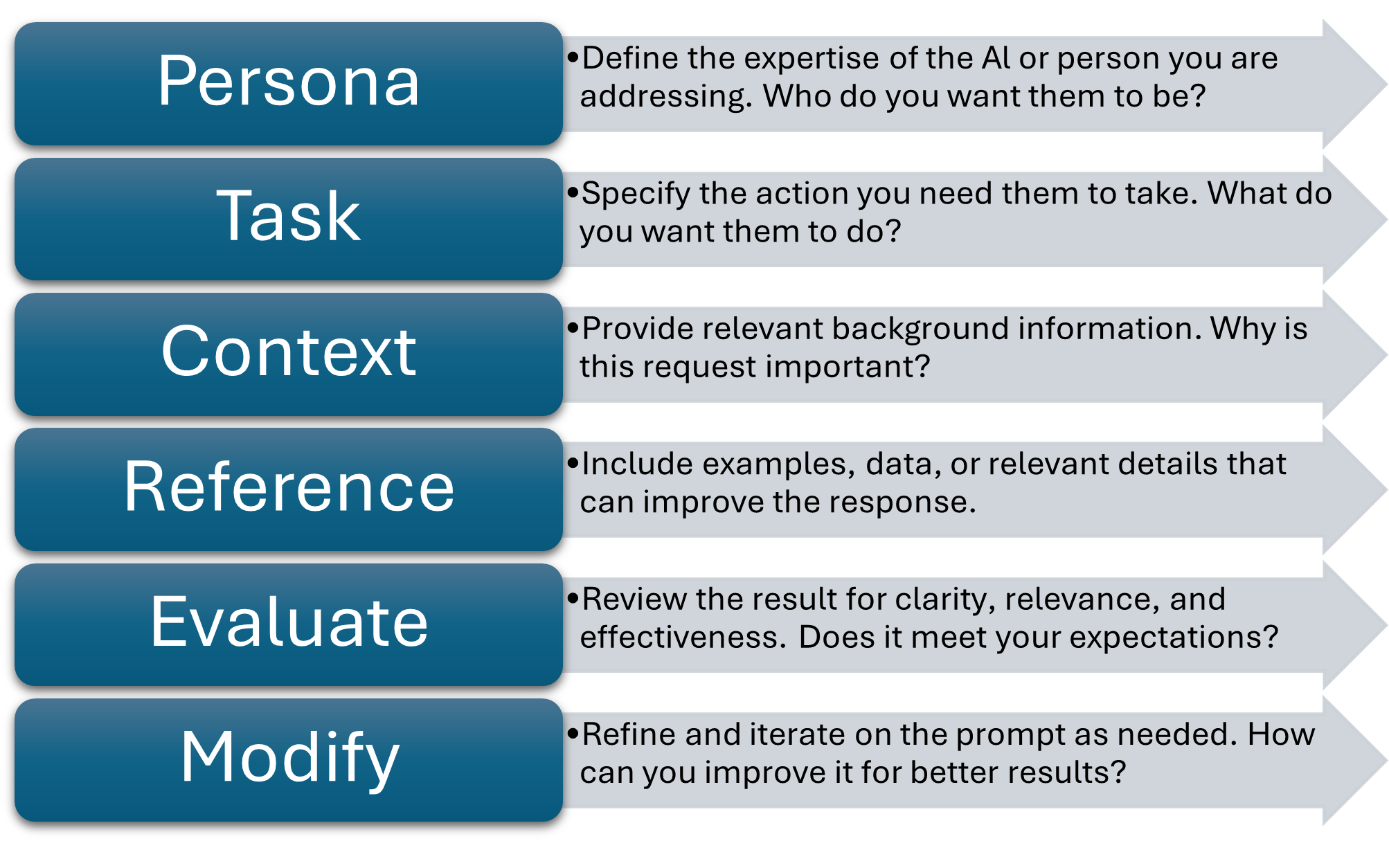
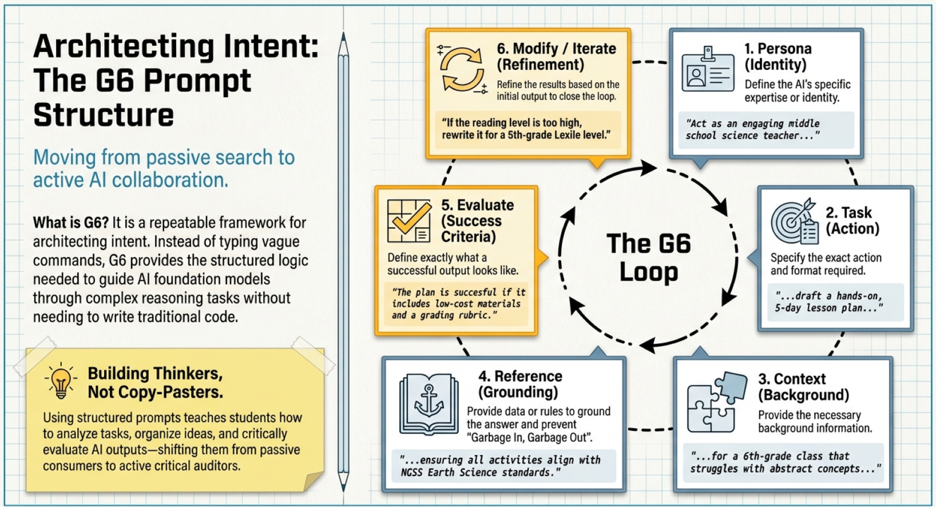
Prompt Engineering is the way in which we communicate with GenAI. In this new era of artificial intelligence, we must learn how to properly prompt GenAI to ensure we get the most accurate, relevant, and useful responses. By crafting clear, specific, and well-structured prompts, we guide AI to understand our intentions and provide the information or assistance we seek. The G6 Prompt structre allows us to tap into the full potential of GenAI, enabling us to solve problems, enhance creativity, and make informed decisions more efficiently. Whether we’re asking for explanations, generating ideas, or solving complex tasks, effective prompt engineering empowers us to interact with AI in a way that aligns with our goals.
Follow our G6 Prompt Structure
G6 Prompt Structure
Persona Create the expertise you want the GenAI to draw from. For example, a manager, a student, a scientist or an analyst.
Task The task you want the GenAI to help you with. For example, creating an e-mail, writing a summary, or analyzing data.
Context Includerelevant details or background information and the reason for the task. This helps the model understand what you want.
Reference Provide examples and additional resources for the GenAI to follow. For example, when showing your hair stylist an image of the cut you want.
Evaluate Review the GenAI output to ensure it is correct.
Iterate If the output is not correct always be iterating. Continue to clarify what you need until it is right.
Most people don’t grow up knowing what they want to do for a living. I wasn’t most people, or at least I didn’t think I was. I grew up with an insane amount of empathy for animals. As a kid, my mom recalls me expressing compassion every time we passed “roadkill,” and to this day, feel free to judge, I still put worms that get washed onto the pavement back into the dirt before they get fried by the sun. I truly cared about every living being, no matter how small—except for roaches. I cannot with those.
Anyway, I had it all planned out. I was volunteering at farm sanctuaries and shelters, attending college programs where I had the most amazing experiences. I learned how to suture at UGA, witnessed a horse get an ultrasound at Tuskegee, and studied lemurs from INSIDE the enclosure at the Duke Lemur Center. I was GOOD at what I was doing and enjoyed every moment of it. I had it all figured out… until I didn’t.
The Turning Point
As planned, I entered college as a Biology major on the pre-vet track. I was so excited to find my people and get to learning, but I quickly found many reasons why this path was no longer right for me. One reason was that I was surrounded by people I just couldn’t relate to. Some casually talked about castrating bulls on their family farms, while others had horses flown in from Germany. Yes, I said flown—on actual planes. I didn’t even know they put horses on planes. Meanwhile, I was just a suburban girl who felt bad for fried worms. I mean, I literally saved a baby bird at one of those college programs with a couple of other students, while the majority of students literally couldn’t care less. I was like, “Isn’t this why we’re all here?”
Freshman year was great. I was having the time of my life making new friends by participating in all of the fun campus activities designed for freshmen. But when Spring break rolled around, I was excited for a week free of work. Then, we all went home and were told to stay there—COVID had made its way to the U.S., and we were on lockdown. My freshman year was cut short.
During this time, I started thinking about Computer Science. It had always been in the back of my mind—my “Plan B.”
Why Computer Science?
COVID underscored the value of job flexibility, making remote and hybrid work a standard part of the modern workplace. Many businesses struggled because they couldn’t adapt. My old dance studio, for example, had to rethink its business model when parents could no longer safely bring their kids to class. Job flexibility meant job security, and it became something I desired.
You can definitely be a remote or hybrid Software Engineer. In fact, I’m a remote Software Engineer right now!
Another pro was that I wouldn’t have to apply to and attend vet school, meaning I could start working sooner and pursue higher education at my own pace. Lastly, I’ve always enjoyed playing video games and solving problems. Right now, I’m obsessed with Marvel Rivals, but I’ve spent thousands of hours on games like Overwatch and Rainbow 6 Siege. Once I made the switch to Computer Science, I was immediately surrounded by nerdy gamers like myself.
Now, as someone who has graduated, most of my friends are Computer Science majors, and I don’t think I can name one who doesn’t own a console or PC. Not only did I find my people, but I found my passion. I love being the boss of computers.
When I first started taking Computer Science classes, I was shocked at how… not bright… computers are (I’m scared to call them dumb in case they take over the world). But seriously, computers are only as smart as we make them. Technology is intertwined with everything nowadays, meaning there are bound to be openings in any field of interest. For example, I’m currently working in education, but for those interested in games like myself, pursuing a job as a Game Developer could be an exciting opportunity. The possibilities are endless.
Pursuing Computer Science
Now, I want to talk to those of you who are already studying Computer Science or are planning to because there are so many things I wish I had known while I was still in school. No, I don’t mean the basic things that everyone tells you (but probably still don’t do) like “take advantage of office hours,” “don’t cram for exams,” and “join clubs.” While those things are important, my goal is to share something you may not already know—something useful that can make you stand out and build your confidence.
1. Apply for Internships
My first piece of advice is to apply for internships. I know, I know, you’ve heard this a million times, but I have to say it because if you’re like me and you switched your major, you may feel behind your peers. My résumé was packed with things like fostering dogs, volunteering at animal shelters, and college vet programs. Even if you’re doing well, you might feel like everyone else knows more. Many of them probably do, especially if they’ve been studying Computer Science longer.
But don’t let that deter you from applying to internships. Imposter Syndrome is real, and the best way to combat it is when you’re still in an environment where you’re not expected to be an expert. Internships are there to teach you—they’re like summer camps for your career. Not only will you gain experience that boosts your confidence, but internships also give you a chance to network. Lots of graduates get offers from companies where they interned, so the more internships you have, the better.
If you get an internship, make sure to foster good relationships, showcase your ability to learn, and try to stay in touch after you leave. You can do this by connecting with your mentors on LinkedIn or even sending thank-you cards or emails.
2. Get Letters of Recommendation
My second piece of advice is to get letters of recommendation whenever possible. Whether you’re doing an internship, volunteering, participating in clubs, or acing a class, get those recommendations!
Target people who know you well—be a familiar face. For example, if you’re interested in Cybersecurity, make yourself known to your professor. Ask questions, study hard, and apply to become a Peer Learning Assistant or Teacher’s Assistant. If that job doesn’t exist, create it! After passing a class, email your teacher and offer to tutor struggling students in the next semester. Show your passion, be memorable, and ask for a recommendation.
You can even write a base version of the letter for them to edit, saving them some time and effort. If you have several professionals who believe in you, a recruiter or employer will take notice.
3. Code Like a Pro
Treat your college experience as a trial run for your future career. When working on group projects, don’t just divide the work like it’s a PowerPoint presentation where each person handles their own slide. In the real world, software engineers succeed through deep collaboration. They work on top of each other’s code, review it, improve it, and solve problems together.
Use GitHub like you would in the workplace: designate a project manager (PM) to create a Priority Board and allocate tasks, work on branches, make pull requests, and review your teammates’ work before merging. Code like a future team of developers will be working on this project. Create style guides, add testing files, and even automate tests with GitHub Actions. Go a step further and organize daily scrum meetings to address blockers. It may seem formal, but trust me—it’ll set you up for success when you hit the job market.
4. Build Your Portfolio
Another thing I wish I’d known? Build your GitHub portfolio as you go. Many of my college projects were on private repositories or remote servers, which meant I graduated without much to showcase. Start early by creating personal projects that reflect the concepts you’re learning in class. Aim for one high-quality project per semester—nothing flashy, but something that demonstrates thoughtful design and problem-solving skills.
Struggling for ideas? Start small: automate something tedious in your life, create a game, or replicate a simple version of an app you love. It’s not about quantity—it’s about depth and creativity. And yes, recruiters will look at your GitHub, so show them your passion and initiative.
5. Establish Connections
Lastly, one of the biggest lessons I learned after college is the power of networking—it’s how I landed my current job. Seriously, the only reason I have my job now is because I knew somebody who knew somebody. I thought that once I graduated, companies would be fighting over me. Boy, was I wrong.
Being one of 100+ applicants on every LinkedIn job posting makes it a lot harder to get noticed. But if you have a referral from a current employee, you’re more likely to stand out. Networking is critical!
Take advantage of clubs, events, and networking opportunities. Attend hackathons and career fairs. Hackathons are fantastic for learning new skills, networking, and getting quick projects for your GitHub. Career fairs may feel intimidating, but they are one of the best places to put yourself out there and make a lasting impression. Bring a friend, bring your résumé, talk about your personal projects, and don’t be afraid to follow up afterward. Networking is like planting seeds—the more effort you put in now, the more opportunities will grow later.
Conclusion
Pursuing a career in Computer Science is an exciting and rewarding journey, but it demands more than just attending classes and earning a degree. College gives you a great foundation, but remember that every classmate is your competition and your future coworker. Most of them will graduate with the same degree as you, so it’s crucial to set yourself apart.
The good news? College offers endless opportunities to get ahead—internships, projects, networking events, and more. Take advantage of them while you have the chance. Every step you take today brings you closer to standing out tomorrow. The effort you put in now will pay off, and this field is all about solving problems and creating possibilities—that’s exactly what you’ll be doing for yourself along the way.
About the Author, Kayla George is a IT Executive for our student interns. She works closely with our interns to ensure they are on the right path. Follow Kayla on LinkedIn: Kayla George
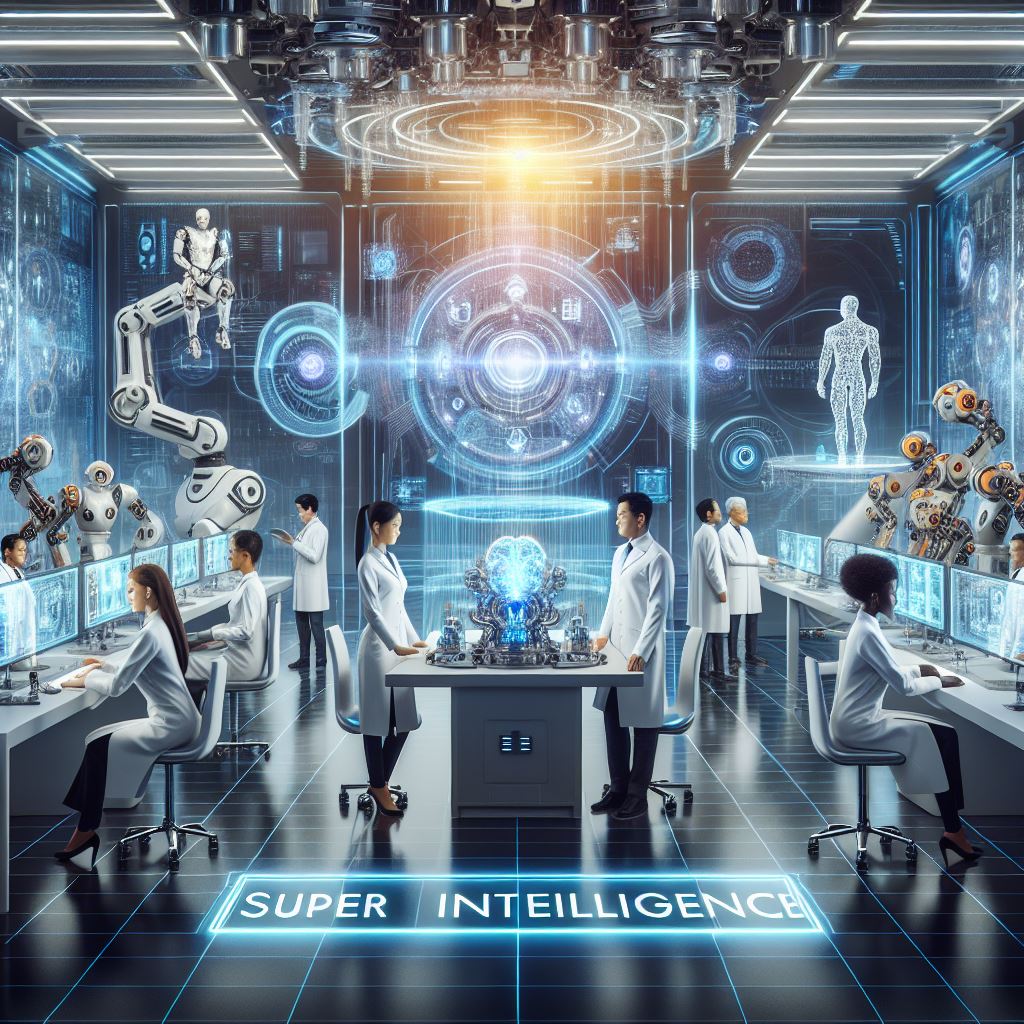
As we venture deeper into the realm of artificial intelligence, we are approaching a pivotal milestone: super intelligence. This term refers to a stage where AI surpasses human cognitive abilities, shaping a future that redefines our daily lives.
Tesla is leading the charge toward this autonomous future, with innovative projects like the personal assistant robot “Optimus.” Designed to communicate like a human and perform a variety of tasks—such as unloading groceries, tutoring children, and even cooking—Optimus embodies the ambition of AI to become increasingly human-like. This quest for acceptance in society drives AI to learn from us, striving to coexist harmoniously alongside humans.
The rise of autonomous technology will undoubtedly have profound implications for our workforce, particularly for blue-collar workers. As automation becomes more prevalent, it’s crucial for individuals in these roles to consider reskilling in technology-driven industries. Those who may find their jobs at risk due to automation will need to explore new career paths or adapt to evolving job markets.
As we embrace this transformative era, we must also reflect on how to find purpose and meaning in our lives when faced with significant change. The journey toward an autonomous future is not just about technological advancement; it’s about ensuring that everyone has a place in this new landscape.